
Two commercial buildings can have nearly the same square footage and still receive roofing proposals that are thousands, or even tens of thousands, of dollars apart. That is not automatically a red flag. It is usually a sign that commercial roofing cost is shaped by far more than roof size alone.
This guide is built to help property owners, facility managers, and decision-makers understand what actually drives commercial roofing cost, how major systems compare, why bids vary so much, and when repair, restoration, coatings, or replacement make the most financial sense. If you are trying to budget with more confidence, this is the page to start with.
Commercial Roofing Cost Overview: Key Takeaways
- Commercial roofing cost depends on roof size, system type, roof condition, tear-off requirements, drainage, insulation, deck condition, access, and project complexity.
- Lower upfront price does not always mean lower long-term cost.
- Repair, restoration, coatings, and replacement each carry different cost profiles and should be evaluated based on roof condition, not just immediate budget pressure.
- Commercial roof bids can vary widely because contractors may be pricing different scopes, assumptions, and levels of long-term value.
- Kansas weather can affect both the current condition of a roof and the cost of the work needed to protect it.
- The smartest way to budget for commercial roofing is to compare short-term cost with life-cycle value and disruption risk.
Quick Commercial Roofing Cost Comparison
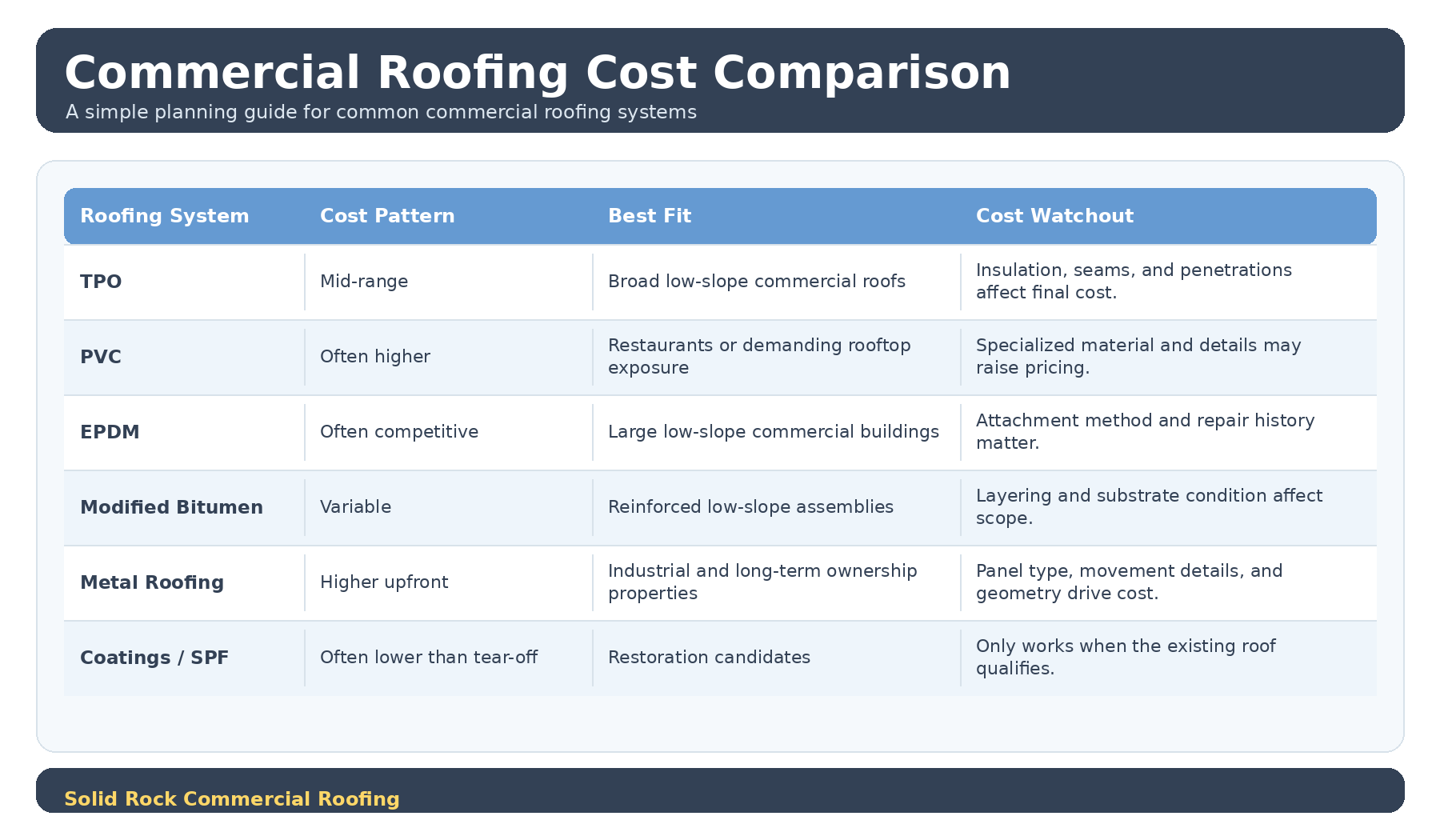
This chart gives readers a fast overview of how common commercial roofing systems compare before they move into the full cost discussion below.
What Commercial Roofing Costs Actually Include
When owners search for commercial roofing cost, they are usually looking for one clear number. The challenge is that roofing cost is not just material cost. It is the cost of the full scope required to protect the building properly.
Depending on the project, that scope may include tear-off, disposal, deck repairs, insulation upgrades, tapered drainage work, membrane or metal installation, flashing details, penetrations, edge metal, warranty requirements, staging, and project coordination around building operations.
That is one reason a cost guide belongs alongside your broader commercial roofing guide and your commercial roofing systems comparison page. Cost is one of the final decision filters, not the only decision factor.
Average Commercial Roofing Cost Ranges by System
The ranges below are best used as planning references, not universal pricing guarantees. Actual cost depends on the roof’s size, layout, condition, access, and scope of work.
| System | Typical Cost Pattern | What Often Drives Cost | Best Used For |
|---|---|---|---|
| TPO | Often positioned as a mid-range low-slope option | Installation quality, seam detailing, insulation, penetrations | Broad commercial low-slope use |
| PVC | Often higher than some other single-ply options | Material specification, rooftop exposure, system detailing | Buildings needing specialized performance characteristics |
| EPDM | Often competitive for large low-slope roofs | Roof size, attachment method, insulation, repair history | Large low-slope commercial properties |
| Modified Bitumen | Can vary based on assembly complexity | Layering, substrate condition, detail work | Reinforced low-slope assemblies |
| Metal Roofing | Often a higher upfront investment with long-term value potential | Panel type, details, penetrations, building geometry | Industrial and long-term ownership properties |
| Coatings / Restoration / SPF | Often lower than full tear-off when the roof qualifies | Prep work, repairs, compatibility, moisture conditions | Roofs with remaining service-life potential |
Actual project pricing should be based on inspection findings, system selection, code requirements, access conditions, and the specific building scope.
What Actually Drives Commercial Roofing Cost?
Cost differences usually come from scope, not guesswork. Two bids that look far apart may be pricing two very different versions of the job.
- Roof size and complexity: Larger roofs are not always cheaper per foot if the layout is complex or crowded with penetrations and equipment.
- Tear-off and disposal: Removing existing material and handling disposal changes cost quickly.
- Insulation upgrades: Changing insulation thickness or adding tapered systems can improve performance but increase project scope.
- Deck condition: Damaged or deteriorated decking can add repair work before the new system goes on.
- Drainage corrections: Ponding issues often require more than just a new surface layer.
- Accessibility and staging: Limited access, active tenant use, or difficult logistics can affect labor and scheduling.
- Warranty level and specification: Not every roof is being priced to the same standard of long-term support.
For a more detailed look at why pricing can change so much, see why two commercial roofing bids can differ by 30–40%.
Cost by Roofing System
System choice plays a major role in project cost, but the right question is not “which roof is cheapest?” It is “which roof creates the best value for this building?”
TPO and PVC
TPO and PVC roofing are often compared together, but their pricing can separate depending on material specification, building use, and the level of detail required. The best fit depends on performance needs, not just membrane category.
EPDM
EPDM roofing is often part of the cost conversation on larger low-slope roofs where owners want a familiar commercial system with practical serviceability.
Modified Bitumen
Modified bitumen roofing can be a strong option when owners want a reinforced low-slope assembly, but cost shifts with layering, details, and the underlying condition of the roof.
Metal Roofing
Metal roofing may carry a stronger upfront price in some applications, but that does not mean it is the wrong choice. On the right building, long-term durability can change the value picture.
Coatings, Restoration, and SPF
Commercial roof coatings and spray polyurethane foam may offer a lower-disruption cost path when the existing roof still qualifies for restoration.
Repair vs. Restoration vs. Replacement Cost Comparison
This is often the most important financial comparison on the page. Some roofs need a targeted repair. Some can gain years of life through restoration. Others are already beyond the point where another patch or coating creates real value.
- Repair can be the lowest immediate cost when issues are localized and the larger system still has meaningful life left.
- Restoration or coatings may cost less than replacement when the roof is still a viable candidate and the goal is controlled life extension.
- Replacement often becomes the smarter financial move when recurring problems, wet insulation, widespread failure, or advanced aging have made smaller fixes less efficient.
The strongest internal pages for this conversation are commercial roof repair, commercial roof restoration, and commercial roof replacement.
For deeper context, review restoration vs. replacement and replacement vs. ongoing repairs over 20 years.
Why Roofing Bids Can Vary So Much
A low bid is not automatically the best deal, and a higher bid is not automatically overpriced. Often, those proposals are pricing different assumptions.
One contractor may be pricing repairs to the visible problem. Another may be pricing the hidden causes too. One may include upgrades or longer-term scope protection. Another may be pricing the minimum necessary to get the project moving. That is why comparing bids means comparing scope, documentation, materials, details, assumptions, and warranty language, not just the final number.
This article on why roofing bids can differ by 30–40% is one of the best follow-up reads on the site.
Long-Term Cost vs. Short-Term Price
The cheapest option today can become the most expensive option later if it does not solve the actual problem, preserve service life, or fit the building’s future needs. That is why commercial roof budgeting should not stop at price per square foot or proposal total.
Long-term cost includes emergency repair exposure, tenant disruption, energy performance, repeated maintenance, lost time, and whether the chosen solution actually delays or avoids a larger replacement event.
If you are weighing these tradeoffs, this resource on replacement vs. ongoing repairs helps frame the issue more clearly.
Kansas-Specific Cost Factors
Kansas weather is not just a maintenance issue. It can also become a cost issue. Hail, high winds, standing water, freeze-thaw movement, and seasonal timing all shape the condition of commercial roofs and the level of work needed to restore or replace them properly.
- Hail can create visible and hidden damage that changes repair or replacement scope.
- High winds can affect edges, flashings, membranes, and metal details.
- Freeze-thaw movement can accelerate deterioration and reveal underlying weaknesses.
- Timing around storms and seasonal conditions can influence labor planning and urgency.
For more local context, review commercial roofing hail damage, high-wind risks, and freeze-thaw damage.
How to Budget for a Commercial Roof Without Guessing
Budgeting for a commercial roof gets easier when owners stop trying to predict one perfect number too early and start planning around the right variables.
- Start with an inspection and condition-based recommendation.
- Separate immediate needs from long-term needs.
- Compare repair, restoration, and replacement as financial pathways, not just technical options.
- Look at what the building can tolerate in disruption, timing, and cash flow.
- Use documentation and maintenance history to reduce surprises later.
This article on how to budget for roof repairs or replacement is a strong next read for owners who want a more controlled planning process.
Ready to Plan Commercial Roofing Costs With More Confidence?
The most useful cost guide in the world still cannot replace a real building evaluation. If you want to know what makes financial sense for your property, the next step is to compare options against the condition of the roof you actually have.
- Need immediate help? Visit commercial roof repair.
- Exploring a lower-disruption option? Review roof restoration and commercial roof coatings.
- Planning long term? Explore preventative maintenance.
Frequently Asked Questions About Commercial Roofing Cost
How much does a commercial roof cost per square foot?
Commercial roofing cost per square foot varies based on the system, the size and complexity of the building, the existing roof condition, and the full project scope. A simple number without inspection context can be misleading, which is why project-specific evaluation matters.
Why are commercial roofing bids so different?
Bids can vary because contractors may be pricing different scopes, materials, assumptions, repair allowances, warranty levels, or long-term solutions. Comparing bids properly means comparing what is actually included, not just the total price.
Is roof restoration cheaper than replacement?
Sometimes. If the current roof is still a strong candidate for restoration, coatings or restoration systems may cost less than full tear-off and replacement. If the roof has widespread failure or advanced deterioration, replacement may deliver better long-term value.
What adds the most to a commercial roofing project cost?
Major cost drivers often include tear-off requirements, insulation upgrades, deck repairs, drainage improvements, rooftop penetrations, access conditions, and the complexity of the building. Material choice matters, but scope often drives the biggest changes.
Is the cheapest roof the best financial choice?
Not always. A lower upfront price can become more expensive later if it leads to repeated repairs, lower service life, more disruption, or a roof system that does not fit the building well. Long-term value is usually a better guide than initial price alone.
This article is a collaboration between Solid Rock Corporation and OpenAI’s ChatGPT. Created on April 23, 2026, it combines AI-generated draft material with Solid Rock’s expert revision and oversight, ensuring accuracy and relevance while addressing any AI limitations.