When the Roof Starts Causing Problems
Most roof problems do not begin in a dramatic way.
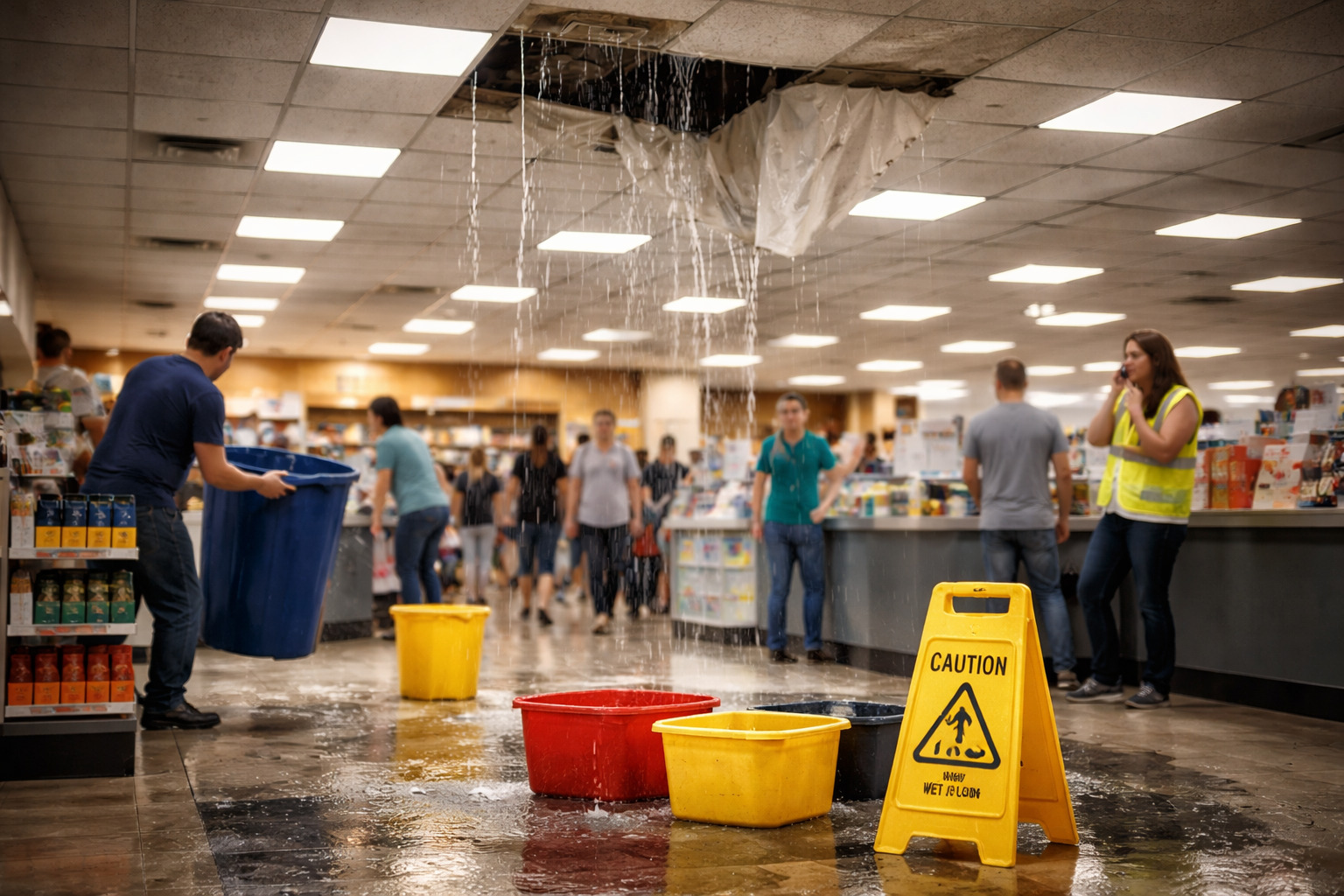
They often start small. A drip forms on a ceiling tile. An employee notices it and places a bucket underneath. At first, it seems minor. Work continues, and customers move through the space as usual.
But then things begin to change.
The drip becomes steady. Water spreads across the ceiling. The tile softens and starts to sag. People begin to notice. Employees shift their attention away from their work to deal with the issue. What felt small just minutes ago now affects the entire space.
In a retail store, checkout lines slow down. In a medical office, appointments are delayed. In a warehouse, work may stop completely.
A roof issue quickly turns into a business problem.
When a commercial roof fails during peak hours, the impact spreads fast. It affects daily operations, safety, and how customers view the business.
Understanding how this happens can help building owners avoid larger problems later.
Key Takeaways
- Roof problems often start small.
What begins as a minor drip can quickly turn into a larger issue that affects the entire building. - Roof failure is usually not sudden.
Most commercial roof problems develop over time due to wear, damage, or lack of maintenance (NRCA). - Peak hours make everything worse.
When a roof fails during busy times, it disrupts operations, affects customers, and increases safety risks. - Business operations can slow or stop.
Leaks can lead to closed areas, delayed service, and reduced productivity across the building. - Revenue loss can happen quickly.
Even short disruptions during high-traffic hours can result in missed sales and delays. - Safety risks increase right away.
Water can create slip hazards, damage electrical systems, and weaken ceiling materials. - Hidden damage can be costly.
Water can spread beyond what you see, leading to mold, structural issues, and larger repairs. - Small warning signs matter.
Stains, odors, and slow drainage can point to bigger problems if left unaddressed. - Regular maintenance reduces risk.
Routine inspections and repairs can extend roof life and prevent major failures (NRCA). - Fast response helps limit damage.
Acting quickly during a roof issue can reduce downtime and prevent further problems. - Your roof supports your business.
A well-maintained roof helps protect your people, equipment, and daily operations.
What “Roof Failure” Really Means
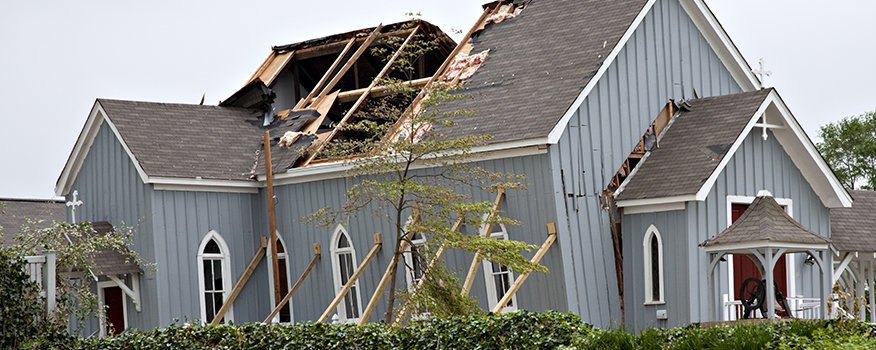
Many people think roof failure means a collapse. In most commercial buildings, that is not the case.
Instead, problems build slowly over time.
Water may enter through a small crack or seam. Flashing around rooftop equipment can wear down. Drains can clog, causing water to sit on the roof. Materials beneath the surface may become wet long before a leak appears inside.
The National Roofing Contractors Association (NRCA) reports that poor maintenance is one of the main causes of early roof failure.
Because of this, many building owners only search for commercial roof repair services after they see water inside. By then, the issue has often been developing for quite some time.
Picture a warehouse in Wichita. A small puncture in the roof goes unnoticed. It does not cause problems right away. Over time, water seeps in and weakens the structure. Then, during a busy workday, the roof begins to leak.
What seems sudden is usually the result of long-term wear.
How Problems Spread During Peak Hours
When a roof fails during busy hours, the effects move quickly.
At first, the problem may seem limited to one area. But commercial buildings rely on connected systems. A single issue can affect multiple parts of the operation.
Employees often step away from their usual tasks to respond. In a store, this means fewer people helping customers. In a warehouse, it may require stopping equipment to prevent damage.
Normal routines are interrupted, and productivity drops.
Customers also react quickly. Some may leave. Others may feel unsure about staying. Even if the issue is fixed soon after, the experience can change how they feel about the business.
The Financial Impact Adds Up
The cost of a roof problem is not always obvious at first.
The business may stay open, but there are still losses.
Sales may slow down. Customers may leave before making a purchase. Parts of the building may need to be closed. Employees may not be able to work as efficiently.
Because peak hours bring the most activity, even a short disruption can lead to lost income.
Buildings that do not follow commercial roof maintenance programs are often more at risk for these issues.
In industrial settings, the impact can be even greater. A leak over equipment can stop production. Even a short delay can affect schedules, shipments, and customer expectations.
Roof problems do not wait for a convenient time—they happen when they happen.
Safety Risks Increase Quickly
When water enters a building, safety becomes a concern right away.
Floors can become slippery. Electrical systems may be exposed. Ceiling tiles may weaken and fall.
The Occupational Safety and Health Administration (OSHA) requires safe working conditions, including protection from hazards related to water and electricity.
During busy hours, these risks increase. More people are moving through the space, and it becomes harder to manage the situation.
A small leak can quickly become a safety issue in a crowded environment.
The Damage You Cannot See Right Away
The visible leak is only part of the problem.
Water often travels beyond where it enters. It can move through insulation, walls, and structural components of the building.
Over time, this can lead to deeper damage. Materials weaken, and mold may begin to grow. Repairs become more complex and costly.
In some cases, the damage becomes severe enough that a full commercial roof replacement is needed instead of a simple repair.
The U.S. Environmental Protection Agency (EPA) explains that controlling moisture is necessary to prevent mold growth.
There are also indirect effects.
Insurance claims may take longer without proper maintenance records. If someone is injured, there may be legal concerns. Some businesses may face inspections or penalties.
The most serious damage is often hidden at first.
Why Timing Makes the Situation Worse
A roof leak at night is very different from one during peak hours.
During the day, buildings are full. Employees are working. Customers are present. Equipment is running.
There is less flexibility to respond. Closing off areas affects operations. Moving people becomes more difficult. Staff are already focused on their tasks.
The timing of the problem can make it harder to control, even if the issue itself is small.
Early Warning Signs Are Easy to Miss
Most roof problems give warning signs before they get worse.
These signs are often small and easy to ignore.
A light stain on the ceiling. A slight odor. Water draining more slowly than usual. These may not seem urgent at first.
Because they do not interrupt daily work, they are often overlooked.
The NRCA recommends regular inspections to catch these issues early.
Consider an office building in Derby. A small stain appears but does not spread quickly. No action is taken. Later, during a storm, that same spot becomes a major leak.
Small signs can point to larger problems ahead.
How Solid Rock Commercial Roofing Helps Reduce Risk
Roofing companies do not all take the same approach.
Some focus mainly on fixing problems after they happen. While that helps in the moment, it does not reduce future risk.
Solid Rock Commercial Roofing focuses on prevention.
The goal is to identify weak points early and address them before they affect operations.
The company works with commercial systems such as flat roofs and coating solutions that help extend roof life.
Being based in Wichita allows for faster response times and a better understanding of local weather conditions.
Local experience helps identify risks tied to the region.
Solid Rock also focuses on practical solutions. Not every roof needs to be replaced. In many cases, repairs or coatings can restore performance while reducing costs and downtime.
The focus remains on keeping businesses running with fewer interruptions.
Maintenance Helps Avoid Disruptions
Regular maintenance plays a major role in preventing roof failure.
Inspections help find small problems early. Repairs can be made before they grow. Maintenance records can support insurance claims if needed.
The NRCA reports that regular maintenance can extend roof life and reduce long-term costs.
Think about two buildings.
One is inspected often and repaired when needed. The other is only fixed after problems appear.
The building with regular maintenance is less likely to face sudden issues during busy hours.
What to Do If a Roof Fails During Business Hours
Even with preparation, problems can still happen.
When they do, safety should come first.
Areas with water should be blocked off. Steps should be taken to control the spread. A professional roofing contractor should be contacted right away.
Trying to fix the issue without proper training can make the damage worse.
A quick response can help limit the impact and restore normal operations sooner.
Conclusion: Protecting Your Business Starts at the Top
Roof problems do not just affect the building—they affect everything inside it.
A leak during peak hours can interrupt work, create safety risks, and lead to lost income. What may seem like a small issue can quickly grow into something much harder to manage.
Many of these situations can be reduced with regular inspections and early repairs.
A commercial roof should be treated as part of daily operations. Taking care of it helps protect employees, customers, equipment, and the flow of business.
If there are signs of wear—or if it has been a while since the last inspection—now is a good time to act.
Solid Rock Commercial Roofing works with businesses across Wichita and nearby areas to help prevent problems before they start.
You can schedule an inspection or speak with a team member today:
???? Visit: https://solidrockcorp.com/contact-us/
???? Call: (316) 227-2628
Taking action now can help keep your business running smoothly when it matters most.
Frequently Asked Questions (FAQs)
1. What is considered a commercial roof failure?
A commercial roof failure does not always mean the roof collapses.
In most cases, it means the roof is no longer keeping water out. This can include leaks, cracks, drainage problems, or damage to the roofing material.
Industry sources like the NRCA explain that many roof failures happen due to long-term wear or lack of maintenance.
2. What should I do if my commercial roof starts leaking during business hours?
The first step is to keep people safe.
Block off the area, control the water if possible, and move anything valuable out of the way. Then call a professional roofing contractor right away.
Trying to fix the problem without proper training can make the damage worse.
3. Can a small roof leak really affect my business?
Yes, even a small leak can cause bigger problems.
During peak hours, a small issue can slow down operations, affect customers, and lead to lost sales. Over time, it can also cause hidden damage inside the building.
4. Why do roof problems often happen during busy times?
Roof problems do not actually “wait” for busy times. They develop over time.
However, they are more noticeable during peak hours because more people are in the building, and business activity is at its highest.
5. How can I prevent my commercial roof from failing?
Regular maintenance is one of the best ways to prevent problems.
This includes inspections, cleaning drains, and fixing small issues early.
The NRCA states that routine maintenance can extend the life of a roof and reduce the chance of major failure.
6. How often should a commercial roof be inspected?
Most commercial roofs should be inspected at least twice a year.
It is also a good idea to schedule inspections after major storms.
Regular checks help catch small problems before they turn into costly repairs.
7. What are the warning signs of roof damage?
Common warning signs include:
- Water stains on ceilings
- Musty odors
- Slow drainage on the roof
- Bubbling or damaged roofing materials
These signs may seem small, but they can point to larger problems developing over time.
8. Can roof damage lead to health or safety issues?
Yes, it can.
Water can create slippery floors, damage electrical systems, and lead to mold growth.
OSHA requires businesses to address these types of hazards to keep people safe.
9. Will insurance cover a commercial roof failure?
Insurance coverage depends on the cause of the damage and your policy.
Claims are more likely to be approved if the roof has been properly maintained and documented.
10. When should I consider roof repair vs. replacement?
If the damage is small or limited, repairs may be enough.
If the roof has widespread damage or ongoing issues, replacement may be needed.
A professional inspection can help determine the best option based on the condition of the roof.
This article is a collaboration between Solid Rock Corporation and OpenAI’s ChatGPT. Created on April 07, 2026, it combines easy-to-read information with Solid Rock’s expert oversight to ensure accuracy and relevance.
External Links:
1. “Commercial Roof Maintenance Manual” – National Roofing Contractors Association (NRCA)
A foundational resource that outlines best practices for inspection, maintenance, and lifecycle management of commercial roofing systems. It provides deeper context on how small issues develop into larger failures when not addressed early.
URL: https://www.nrca.net/NRCA/NRCA/Store/Product-Details.aspx?iProductCode=CRM20
2. “Moisture Control Guidance for Building Design, Construction and Maintenance” – U.S. Environmental Protection Agency (EPA)
This guide explains how moisture moves through buildings and why it leads to structural damage and mold growth. It is especially useful for understanding the hidden consequences of roof leaks discussed in the article.
URL: https://www.epa.gov/mold/moisture-control-guidance-building-design-construction-and-maintenance
3. “Preventing Slips, Trips, and Falls in the Workplace” – Occupational Safety and Health Administration (OSHA)
This resource highlights workplace safety risks tied to water intrusion, including slip hazards and unsafe conditions during active leaks. It reinforces the safety concerns that arise when roof failures occur during peak business hours.
URL: https://www.osha.gov/preventing-slips-trips-falls