As colder weather gets closer in Wichita, commercial building owners and facility managers have a lot to think about. Heating systems need to be ready. Outdoor areas may need seasonal work. Doors, windows, drains, and other parts of the property may also need attention before winter.
The commercial roof belongs on that list. But it is easy to think of a roof as one large surface and miss the smaller parts that help protect the building.
Commercial roof flashing is one of those parts.
Flashing is used in many places where the roof meets another part of the building. You may find it near walls, pipes, vents, HVAC units, roof edges, and drains. These areas can be more complex than the wide, open sections of a commercial roof.
They also face years of sun, rain, wind, heat, cold, and normal building movement. Over time, flashing and the materials around it can wear down. If a weak area allows water into the roofing system, the first sign of trouble may appear inside the building.
This is one reason flashing deserves attention before winter arrives.
Building owners do not need to know how to repair flashing themselves. But knowing what it does, where it is found, and how problems can contribute to leaks can make it easier to care for a commercial property.
Key Takeaways
- Commercial roof flashing helps protect areas where the roof meets walls, pipes, vents, HVAC curbs, edges, drains, and other building components.
- Flashing areas can face added stress because different materials meet in these locations and may expand and contract as temperatures change.
- Age, weather exposure, rooftop activity, equipment changes, and previous repairs can affect flashing and nearby roofing materials over time.
- Water does not always appear inside a building directly below the place where it entered the roof. This can make professional leak diagnosis important.
- Ceiling stains, recurring leaks, moisture near exterior walls, and problems that appear after rooftop equipment work may be signs that the roof needs attention.
- Fall gives facility managers and building owners an opportunity to address known roofing concerns before colder weather and winter precipitation arrive.
- A flashing concern does not automatically mean the entire roof needs major repairs or replacement. A professional evaluation can help identify the source and extent of the problem.
What Does Commercial Roof Flashing Do?
Think about a large section of flat or low-slope commercial roofing. If nothing passed through the roof and the roof never met a wall, the surface would be fairly simple.
Most commercial roofs are not built that way.
Pipes may pass through the roof. HVAC equipment may sit above it. Vents and exhaust systems may need openings through the roofing surface. The roof may also meet walls, raised curbs, drains, or other parts of the building.
Each of these areas interrupts the main roofing surface.
That is where commercial roof flashing plays an important role.
Flashing helps protect the places where the roof meets another surface or building part. It helps the roofing system continue to manage water around these more complex areas.
There is no single type of flashing used on every commercial building. The materials and design can depend on the roof system, the building, and the location of the flashing.
A simple example is a pipe that comes through a roof.
The main roofing material cannot pass straight through the pipe. Instead, the roof has to fit around it. That area still needs protection from water even though the main roof surface has been interrupted.
A similar situation exists where a roof meets a wall. The horizontal roofing surface ends, but the building still needs protection at the point where the two surfaces meet.
Flashing helps protect these areas.
Although flashing may cover only a small part of the total roof, where it is located can make it important to the performance of the roofing system.
Why Roof Connections and Penetrations Need Attention
A wide section of roofing material faces different conditions than an area where several parts of a building come together.
Around a penetration or roof connection, there may be seams, joints, different materials, and changes in height. All of those parts have to work together while facing the weather.
Heat and cold can also affect these areas.
Building materials can expand when temperatures rise and contract when temperatures fall. Not every material moves in exactly the same way. After many cycles of hot and cold weather, some connections may experience added stress.
Normal work on the roof can affect these areas, too.
For example, many commercial buildings have HVAC equipment on the roof. Service workers may need to visit those units several times over the years. The roofing around the equipment may see more activity than a section of roof that people rarely walk near.
Imagine a commercial building with four rooftop HVAC units. Most of the roof may still be in good condition, but the flashing around one equipment curb may have started to separate or wear.
Nothing may be visible inside the building during a long stretch of dry weather.
Then Wichita gets several days of rain.
If water finds a weak point near that equipment curb, moisture may enter the roofing system. The opening does not have to look large or dramatic to cause a problem.
This does not mean every worn-looking area is leaking. It does mean that roof connections and penetrations are worth checking when there are signs of trouble.
Where Is Flashing Found on a Commercial Roof?
Flashing can be found in many places on a commercial roof. Knowing a few common locations can help building owners understand what a roofer is talking about during an inspection or repair discussion.
One common location is where the roof meets a wall.
Many commercial buildings have parapet walls that extend above the roof. The roofing system has to meet these vertical surfaces while continuing to help keep water out of the building. Flashing is often part of that connection.
Pipes and vents are another common area.
A commercial building may have many items that pass through the roof. These can include plumbing vents, exhaust pipes, conduits, and other equipment. Each opening creates a break in the main roof surface.
HVAC equipment can create several more areas where flashing is needed.
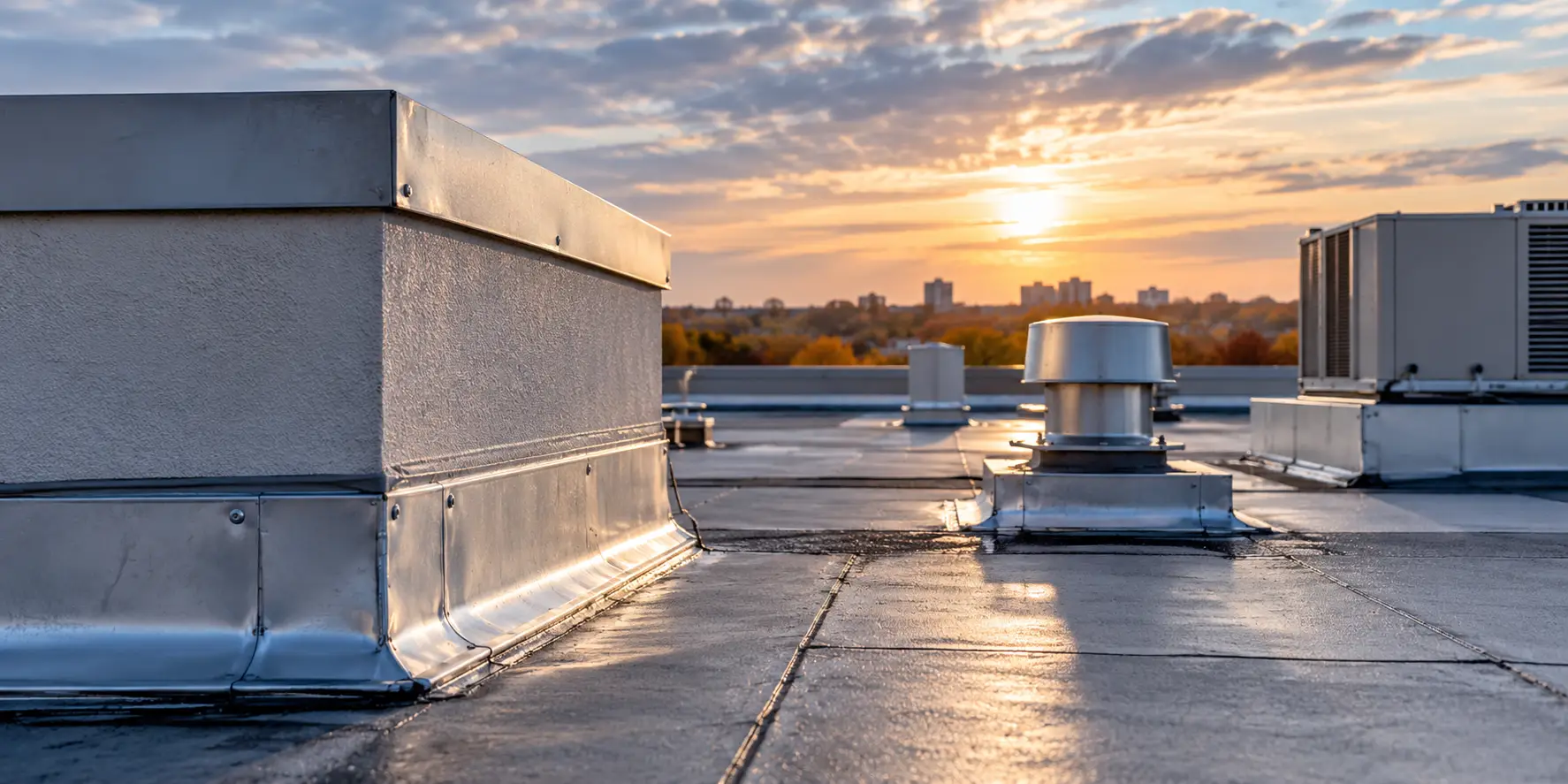
Many rooftop units sit on raised curbs rather than directly on the roof surface. The roof meets the sides of these curbs, so those connections need protection. If equipment is replaced or changed later, the roofing details around it may also need attention.
Flashing may also be found around roof edges and other perimeter areas. These parts of the roof can face strong winds and changing weather.
Drainage areas are important as well.
Commercial roofs need a way to move rain and melting snow away. Some buildings use internal drains. Others may use scuppers, gutters, or a mix of drainage parts. The roofing materials around these areas need to work with the drainage system so water can leave the roof.
Some buildings also have expansion joints. These are designed to allow certain parts of a building to move. Roofing details in these locations need to allow for that movement while still helping protect the building from water.
Every commercial building is different. A warehouse may have a simple roof with only a few penetrations. A large office or manufacturing building may have many pieces of rooftop equipment.
The more complex the roof is, the more places there may be where the main roofing surface meets another part of the building.
What Happens to Flashing as a Roof Gets Older?
A commercial roof spends its life outdoors.
In Wichita, a roof may face hot summer days, freezing winter weather, wind, rain, snow, and hail. Temperatures can also change a great deal over the course of a year.
Those conditions can affect roofing materials over time.
Flashing is no exception.
Depending on the roof and the materials used, seams may begin to wear. Sealants can age. Materials may loosen or move. Repeated heating and cooling can place stress on areas where different parts of the roofing system meet.
The history of the building can matter, too.
Commercial properties often change over the years. An old HVAC unit may be removed and replaced. A new vent may be added. Pipes or other equipment may be changed. Roof repairs may also have been made by different contractors at different times.
All of that work becomes part of the roof’s history.
A facility manager may not know everything that happened to the roof before taking responsibility for the property. Even good maintenance records may not show the current condition of every roof detail.
There is another issue: a roof problem is not always easy to see.
An area that looks different does not always mean there is an active leak. At the same time, a small opening may allow moisture into the roof without creating an obvious sign on the surface.
For that reason, recurring leaks or other signs of moisture deserve a closer look rather than guesswork.
Why Cold Weather Makes Existing Concerns Worth Checking
Cold weather does not suddenly cause every flashing problem. A weak area may have been developing for months or even years.
Fall, however, gives property owners a chance to address known concerns before winter weather arrives.
By this time of year, a commercial roof has already gone through summer heat, storms, wind, and normal use. As temperatures begin to fall, the materials continue to expand and contract.
If an area of flashing is already damaged or worn, winter weather can place more stress on it.
Moisture is another concern.
Suppose a small opening already exists where two roofing materials meet. During dry weather, there may be no clear sign of a problem. Rain or melting snow can change that.
If water gets into the roofing system, the problem may not stay on the roof.
Moisture may reach insulation or other materials below the roof surface. It may eventually show up inside the building as a ceiling stain, damp area, or active drip.
For a facility manager, that can create more work very quickly.
An active leak above an office, storage area, or workspace may require staff to move equipment or protect inventory. Tenants or employees may have to avoid part of the building. Someone then has to arrange for the roof to be checked and the source of the water to be found.
A roof concern that could have been checked during mild weather has now become an active problem during cold or wet conditions.
For owners looking for commercial roofing Wichita services, checking a concern before winter does not mean assuming a large repair is needed. The purpose is to find out what is happening and whether the area needs professional attention.
Why a Roof Leak May Not Be Where You Think It Is
A commercial roof leak can be confusing because water does not always appear directly below the place where it entered the roof.
Imagine that a facility manager walks into an office after a heavy rain and notices a stain on a ceiling tile.
The natural response may be to think that the leak must be directly above that stain. Sometimes it may be. In other cases, water may have entered somewhere else and moved through part of the roof or building before becoming visible.
For example, suppose a ceiling stain appears several feet away from an outside wall.
The source might be a problem where the roof meets that wall. It might also be connected to a nearby pipe, equipment curb, seam, or another roofing detail.
The stain tells the facility manager that moisture may be present. It does not always show exactly where the water entered.
This becomes even more important when a leak keeps returning.
A repair may appear to solve the problem during dry weather. Then another storm arrives, and water shows up in the same part of the building.
At that point, finding the actual source becomes especially important.
Professional commercial roof leak repair Wichita KS involves looking at the source of the leak and the roofing areas around it rather than making assumptions based only on where water appears indoors.
Treating a ceiling stain and finding the place where water entered the roof are two different things. The source needs to be understood before the right roofing work can be determined.
What Signs Should Facility Managers Watch For?
Facility managers do not need to diagnose roof flashing problems. Their job is not to decide exactly which roofing material has failed or how it should be repaired.
What they can do is notice changes in the building.
A new ceiling stain after rain is useful information. So is water near an outside wall or in an area that has leaked before.
Patterns can tell a story, too.
Perhaps a small leak appears only when rain is driven by strong winds. Maybe a stain returns in the same area after several storms. A facility manager may also notice that a problem began after rooftop equipment was installed or serviced.
These details can help a commercial roofer investigate the problem.
Keeping simple records can also help. A facility manager can note when moisture appeared, what the weather was like, where the water was seen, and whether the same area has had problems before.
This does not require anyone to climb onto the roof.
Commercial roofs can have fall hazards and other safety risks. Roofing systems also use different materials and installation methods. Trying to pull at flashing, apply sealant, or make a quick repair without knowing the roof system can create new problems or make the existing problem harder to identify.
Observing conditions from safe areas and keeping good records can give a roofing professional useful information without putting building staff at risk.
Flashing Is Only One Part of the Roof
Flashing can contribute to water intrusion, but it should not be blamed for every commercial roof leak.
A roof is a complete system.
The main roofing material, flashing, drains, penetrations, edges, previous repairs, and materials below the roof surface all have a role. A leak may involve one area, or several conditions may be involved.
This matters when a building owner is deciding what to do next.
Imagine that a roofer finds one problem around a pipe penetration while the surrounding roof remains in good condition. That situation may be very different from a roof with several worn areas and a long history of leaks.
In the same way, an interior leak does not automatically mean that the whole roof needs to be replaced.
Building owners need clear information about what is causing the problem, the condition of the nearby roofing materials, and what type of work may be appropriate.
Those answers can help with repair decisions, maintenance planning, and future roofing budgets.
Why Review Known Roof Concerns Before Winter?
Facility managers often have to decide which property issues need attention now and which ones can be planned for later.
Roofing concerns are part of that job.
One building may have a ceiling stain that appeared once during a summer storm. Another may have an area near an HVAC unit that has leaked several times. A third property may simply have an older roof, and the owner wants to know more about its condition before winter.
Fall can be a useful time to revisit these concerns.
Instead of asking whether the entire roof needs work, a building owner can ask a simpler question:
Are there areas of the roof that should be checked before cold weather arrives?
Flashing, penetrations, roof-to-wall connections, equipment curbs, roof edges, and places with a history of leaks may all be worth discussing with a commercial roofing professional.
An inspection may find a concern in one small area. It may point to a larger issue that needs attention. It may also give the building owner information that can be used for future planning.
The goal is not to assume the worst. It is to get a clearer idea of the roof’s condition before a small concern has a chance to cause a larger disruption.
Conclusion
Commercial roof flashing may cover only a small part of a roof, but it is used in many places where water needs to be carefully managed.
It can be found where roofs meet walls, around pipes and vents, near HVAC equipment, along roof edges, and around other building parts. These areas face the same weather as the rest of the roof while also dealing with seams, connections, movement, and normal wear.
When flashing or the materials around it become damaged, water may have a path into the roofing system. The first sign may be a stain, damp area, or leak inside the building. Because water can travel before it becomes visible, finding the true source may require a professional evaluation.
Before cold weather arrives in Wichita, building owners and facility managers can review any roof concerns they already know about. Recurring leaks, old ceiling stains, problem areas near rooftop equipment, and other signs of moisture are good reasons to have the roof checked.
Knowing what is happening gives you better information for planning repairs and maintaining your property.
If you have concerns about flashing, leaks, or other areas of your commercial roof, contact Solid Rock Commercial Roofing for a free estimate. Visit https://solidrockcorp.com/contact-us/ to set up your appointment with Solid Rock Commercial Roofing, or call (316) 227-2628 to learn more.
Frequently Asked Questions
What is commercial roof flashing?
Commercial roof flashing helps protect areas where a roofing system meets another surface or building component. Common locations include walls, pipes, vents, HVAC equipment curbs, roof edges, and other roof openings or connections.
Why is flashing important on a commercial roof?
Flashing helps manage water in areas where the main roofing surface is interrupted. Because these locations can include seams, joints, and different materials, problems with flashing or the surrounding roofing materials may create a path for water to enter the roof system.
Where is flashing commonly found on commercial roofs?
Flashing may be found around roof penetrations, parapet walls, roof-to-wall connections, HVAC curbs, perimeter areas, drains, and certain structural joints. The exact locations and materials depend on the building and roofing system.
Can damaged flashing cause a commercial roof leak?
Damaged or deteriorated flashing can contribute to water intrusion, but flashing is not the cause of every roof leak. The roof membrane, penetrations, drainage areas, previous repairs, and other parts of the roofing system may also be involved.
Why can a commercial roof leak appear away from its source?
Water can sometimes move through parts of the roof or building before becoming visible indoors. A ceiling stain may show that moisture is present without showing exactly where the water entered the roofing system.
What are some signs that a commercial roof should be checked?
Recurring ceiling stains, visible moisture, leaks after rain or snow, problems near exterior walls, and leaks that begin after rooftop equipment work can all be reasons to have the roof evaluated. Keeping notes about when and where a leak appears can also help a roofing professional investigate its source.
Why should flashing concerns be addressed before winter?
Existing weak areas may face more moisture and temperature changes during winter. Having known concerns checked before colder weather arrives can help building owners understand the roof’s condition before an active leak causes disruption inside the property
Does a flashing problem mean the entire commercial roof needs replacement?
Not necessarily. A flashing concern may be limited to one area, while another building may have more widespread roofing issues. A professional evaluation can help determine the condition of the affected area and the surrounding roof.
Should facility staff repair commercial roof flashing themselves?
Commercial roofing systems vary in materials and construction, and working on a roof can create safety risks. Facility staff can document interior signs of moisture and other observations, while evaluation and roofing work are better handled by qualified commercial roofing professionals.
This article is a collaboration between Solid Rock Corporation and OpenAI’s ChatGPT. Created on Sep 30, 2026, it combines easy-to-read information with Solid Rock’s expert oversight to ensure accuracy and relevance.
Recommended Reading
Whole Building Design Guide (WBDG)
WBDG provides technical building-envelope guidance useful for professionals who want more context on roof assemblies, moisture control, drainage, and the connections between roofing systems and other building components.
URL: https://www.wbdg.org/
FEMA Building Science
FEMA’s Building Science resources cover building performance during severe weather, including guidance related to roofs, wind resistance, building-envelope components, and reducing damage to commercial and other structures.
URL: https://www.fema.gov/emergency-managers/risk-management/building-scienceNational Roofing Contractors Association (NRCA)
NRCA provides roofing-industry technical information, standards, research, and educational resources. Its materials can provide additional professional context on commercial roof systems, roof details, maintenance, and industry practices.
URL:https://www.nrca.net/