Key Takeaways for: Is Your Roof Healthy Enough for a Leak-Stopping Spray Foam Coating?
- Calendar age does not determine whether a roof needs replacement; functional age does.
- Moisture surveys reveal hidden water damage before major decisions are made.
- Spray foam coatings can stop leaks and add insulation when the roof substrate is dry and stable.
- Widespread saturation or structural damage usually requires full replacement.
- Kansas weather patterns make regular inspections and moisture detection especially important.
- Data-driven evaluations reduce risk and protect long-term building investments.
Restoration vs. Replacement: Is Your Roof Healthy Enough for a Leak-Stopping Spray Foam Coating?
Commercial roof leaks often trigger an immediate question: Should you replace the entire roof, or can it be restored? The answer depends less on how old the roof is and more on its functional condition.
Many building owners assume that once leaks begin, roof replacement is inevitable. In reality, a properly conducted moisture survey can determine whether your roof still has years of service left. When the underlying system is dry and structurally sound, a spray polyurethane foam (SPF) coating may provide a cost-effective, leak-stopping solution.
Understanding how moisture surveys define functional age helps commercial property owners make informed, financially responsible decisions.
What Is the Difference Between Roof Restoration and Roof Replacement?
Roof replacement involves removing the existing roofing materials down to the deck and installing an entirely new system. This process includes tear-off, disposal, insulation replacement, and new membrane installation.
Roof restoration, on the other hand, leaves most of the existing roof intact. After cleaning and repairing damaged areas, a coating system—such as spray foam—is applied over the surface.
According to the National Roofing Contractors Association (NRCA), maintenance and proper evaluation play a significant role in extending roof life cycles. [High Confidence]
Replacement is appropriate when structural components fail. Restoration is appropriate when the system remains largely intact.
What Is a Spray Foam Roofing System and How Does It Stop Leaks?
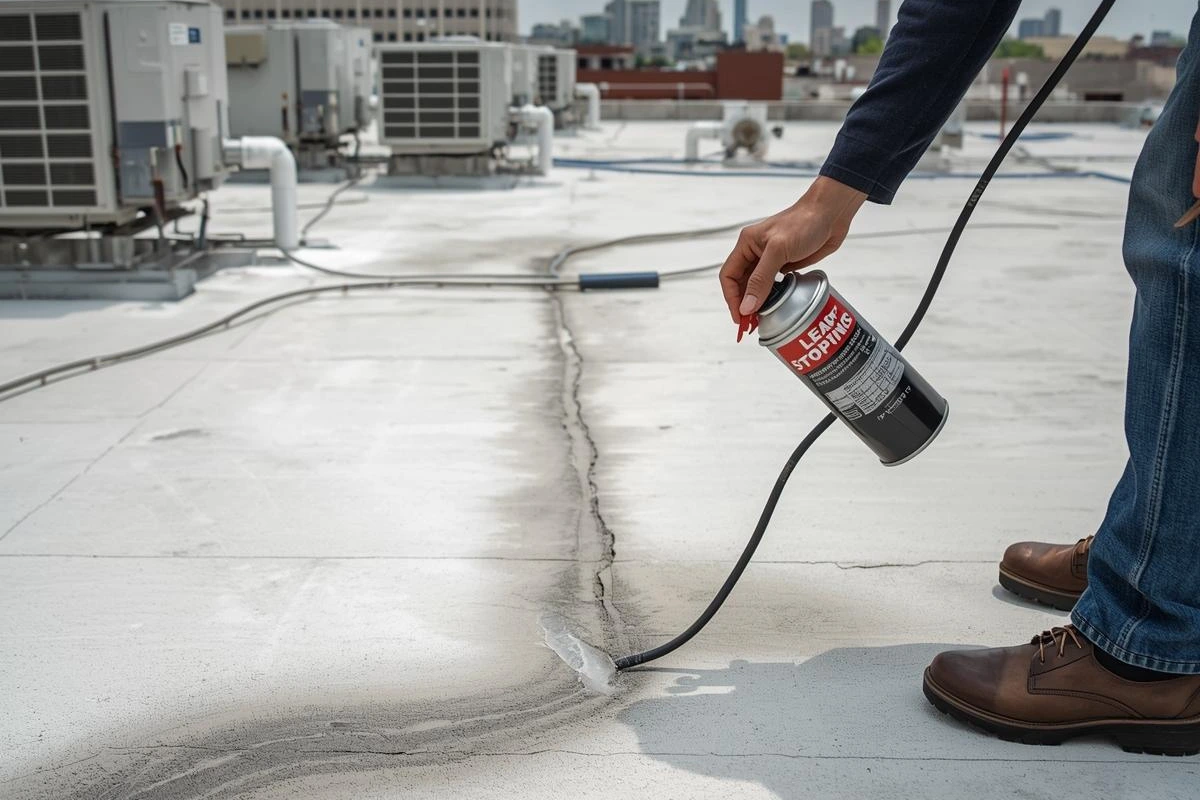
Spray polyurethane foam roofing is a liquid-applied material that expands into a seamless, fully adhered surface. Because it forms a continuous layer, it eliminates many common leak entry points like seams, joints, and fasteners.
The U.S. Department of Energy notes that SPF provides both insulation and air sealing benefits in building systems. [High Confidence]
Key characteristics include:
- Seamless surface
- Added R-value for energy performance
- Reduced penetrations and joints
For commercial buildings in Kansas, where temperature swings are common, improved insulation can help stabilize interior conditions.
What Is a Moisture Survey and Why Is It Important?
A moisture survey identifies trapped water within a roofing system. Industry standards, including ASTM methods for roof moisture detection, support pre-restoration testing to prevent sealing in wet insulation. [High Confidence]
Common methods include:
- Infrared thermography: Detects temperature differences indicating moisture
- Nuclear moisture testing: Measures hydrogen content to identify water presence
- Core sampling: Physically confirms findings
Without this data, applying a coating could trap moisture, leading to future deterioration.
What Does Functional Age Mean for a Commercial Roof?
Functional age refers to a roof’s real-world condition rather than its installation date.
For example:
- Roof A: 18 years old, minimal moisture, solid deck
- Roof B: 12 years old, 35% insulation saturation
Despite being older, Roof A may be a better candidate for restoration. Moisture surveys provide the measurable evidence needed to make this determination.
When Is a Roof a Good Candidate for Spray Foam Restoration?
A roof may qualify for restoration when:
- Structural decking is sound
- Moisture intrusion is limited and localized
- Existing membrane is stable
- Drainage patterns are manageable
Hypothetical Scenario: A 60,000 sq. ft. manufacturing facility in Wichita shows 10% isolated wet insulation after infrared scanning. Targeted repairs followed by spray foam coating could extend the roof’s service life without full replacement.
When Is Full Replacement the Smarter Choice?
Replacement is often recommended when:
- Widespread insulation saturation exists
- Structural components show deterioration
- Previous repairs have failed repeatedly
The Environmental Protection Agency has reported that wet insulation reduces thermal performance in building systems. [High Confidence]
Extensive saturation affects energy efficiency and structural integrity, making restoration impractical.
How Do Restoration and Replacement Compare in Cost and Disruption?
Restoration avoids tear-off labor and landfill disposal, which typically reduces project cost. Industry analyses indicate that coating systems can cost 30–50% less than full replacement, depending on system type and region. [Synthesis]
Replacement projects often involve:
- Extended timelines
- Noise and debris
- Operational interruptions
Restoration projects typically move faster and generate less disruption to daily business activities.
How Does a Moisture Survey Protect Your Investment Decision?
Moisture surveys provide objective data. Instead of relying on visual inspection alone, building owners receive mapped documentation of wet and dry areas.
Example Data Snapshot:
| Roof Area | % Moisture Detected | Recommendation |
| Section A | 5% | Repair + Coat |
| Section B | 40% | Replace |
This type of breakdown supports targeted financial planning.
What Should Wichita-Area Building Owners Consider?
Kansas experiences frequent hail events. NOAA’s National Centers for Environmental Information reports that Kansas consistently ranks among states with high hail frequency. [High Confidence]
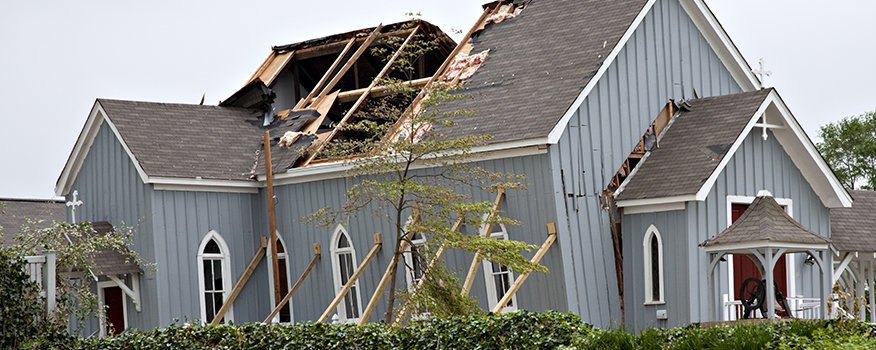
Storm exposure increases the likelihood of membrane punctures and hidden moisture intrusion. Routine inspections and moisture surveys help determine whether storm damage requires restoration or full system replacement.
What Is the Next Step If You Suspect Roof Leaks?
The next step is a professional inspection combined with a moisture survey. Objective testing clarifies whether your roof retains sufficient functional life for spray foam restoration.
By focusing on functional age instead of calendar age, commercial building owners can make financially sound decisions that balance durability, performance, and budget control.
This article is a collaboration between Solid Rock Corporation and OpenAI’s ChatGPT. Created on February 15, 2026, it combines AI-generated draft material with Solid Rock’s expert revision and oversight, ensuring accuracy and relevance while addressing any AI limitations.