Most commercial roofing decisions do not go wrong because the material was “bad.” They go wrong because the wrong system was chosen for the building, the budget, the weather exposure, or the owner’s long-term plan.
TPO, PVC, EPDM, modified bitumen, metal, coatings, and spray foam all have legitimate strengths. The question is not which one sounds best in a sales conversation. The question is which one actually fits your building. This page is built to help property owners, facility managers, and decision-makers compare commercial roofing systems side by side and move toward the right next step with more confidence.
Key Takeaways
- There is no single best commercial roofing system for every building. The right answer depends on use, condition, climate, and ownership goals.
- TPO, PVC, EPDM, modified bitumen, metal, and coating-based systems all serve different priorities.
- Upfront price matters, but life-cycle value often matters more.
- Installation quality, detail work, and maintenance can influence performance just as much as the product category.
- Kansas weather adds real pressure to commercial roofs, especially through hail, wind, standing water, and freeze-thaw movement.
- The smartest roofing comparison is not just system vs. system. It is repair vs. restoration vs. replacement in light of the building’s actual condition.
Quick Commercial Roofing Comparison
This chart gives readers a fast side-by-side view of the major commercial roofing systems before they move into the deeper comparison sections below.
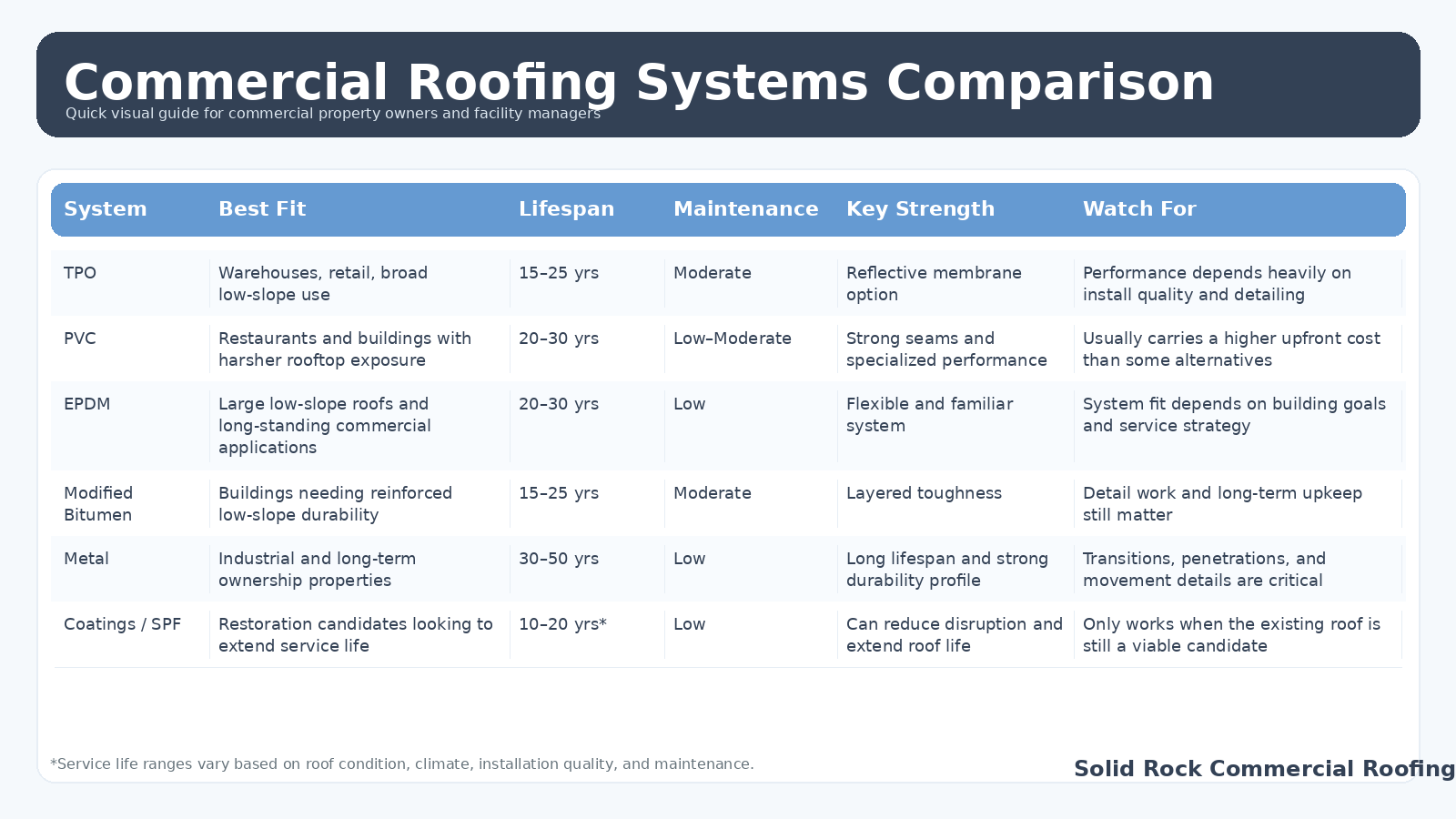
Commercial Roofing Systems at a Glance
| System | Often a Good Fit For | Typical Service-Life Range | Maintenance Profile | Common Strength |
|---|---|---|---|---|
| TPO | Retail, warehouses, broad low-slope commercial use | Often around 15–25 years | Moderate | Reflective membrane option |
| PVC | Restaurants and buildings with more demanding rooftop exposure | Often around 20–30 years | Low to moderate | Strong seams and specialized performance |
| EPDM | Large low-slope buildings and long-standing commercial applications | Often around 20–30 years | Low | Flexibility and familiarity |
| Modified Bitumen | Buildings needing a reinforced low-slope assembly | Often around 15–25 years | Moderate | Layered durability |
| Metal | Industrial and long-term ownership properties | Often around 30–50 years | Low to moderate | Long lifespan potential |
| Coatings / SPF | Restoration candidates that may not need full tear-off | Varies by system and roof condition | Low to moderate | Can extend service life with less disruption |
Service-life ranges vary with installation quality, climate, roof design, traffic, maintenance, and the condition of the existing assembly.
Comparing the Major Commercial Roofing Systems
TPO and PVC Roofing
TPO and PVC roofs often get grouped together because both are single-ply membrane systems used on low-slope commercial buildings. That is useful at a high level, but the comparison becomes more meaningful when you look at the building itself. What is happening on the roof? What kind of exposure will it face? What level of maintenance will the owner realistically support?
TPO is frequently part of the conversation on broad commercial applications where a reflective membrane system is being considered. PVC may become more attractive when the building environment calls for a more specialized performance profile. For a narrower head-to-head discussion, see TPO vs. PVC.
EPDM Roofing
EPDM roofing remains a familiar choice on many commercial roofs. It often enters the discussion on large low-slope properties where flexibility and a long-established commercial track record matter. Owners comparing EPDM to other membrane options usually need to think beyond category labels and look at the actual building goals, leak history, maintenance plan, and expected ownership horizon. This related read on what EPDM roofing is and where it fits provides added context.
Modified Bitumen Roofing
Modified bitumen roofing is often considered when owners want a tougher, reinforced low-slope system. It is part of the comparison conversation less because it wins on a simple “best roof” metric and more because it may align well with buildings that need a durable, layered assembly and a familiar service path.
Metal Roofing
Metal roofing often becomes attractive on buildings where long-term durability and a different structural profile than a membrane system are part of the owner’s priorities. It may be a strong fit for industrial, commercial, and institutional properties, but it still demands careful attention to transitions, penetrations, movement, and long-term detailing.
If you are comparing broader categories rather than only product lines, review metal roofing vs. flat roofing and these pros and cons of metal roofing.
Roof Coatings and Spray Foam Systems
Not every comparison should start with full replacement. Some roofs deserve to be evaluated first as restoration candidates. That is where commercial roof coatings and systems such as spray polyurethane foam can become part of a smarter discussion.
Solid Rock also has dedicated service paths for flat roof coatings, metal roof coatings, and elastomeric coatings. A helpful next read is whether a roof is healthy enough for restoration.
Side-by-Side Roofing Comparisons That Matter Most
TPO vs. PVC
This comparison matters when an owner is already focused on single-ply membranes and is trying to choose between two systems that can look similar from a distance but behave differently depending on the building’s environment and demands. The real question is not which acronym wins. It is which system fits the rooftop conditions and long-term expectations better.
EPDM vs. TPO
This is often a practical comparison for low-slope buildings where the owner wants to balance familiarity, performance, maintenance needs, and the contractor’s recommended path. In many cases, the best answer emerges from how the roof is currently performing and what the ownership strategy looks like, not from a blanket preference.
Metal vs. Flat Roofing Systems
This comparison often comes up on buildings where owners are looking at durability, aesthetics, structural design, and long-term hold value all at once. Flat roofing systems can be a strong fit on many commercial properties, while metal may be better aligned with certain building profiles and ownership plans. The point is not to force a winner. It is to line up the system with the property’s actual needs.
Coating vs. Replacement
This is one of the highest-value comparisons on the page because it is often the one that most directly affects budget, disruption, and long-term planning. Some roofs truly need replacement. Others still have enough integrity left to justify restoration. This is why the condition of the existing roof matters more than the appeal of any one solution.
How Building Type Changes the Comparison
Roofing comparisons become much more useful when they are tied to building type. A warehouse, office, retail center, school, church, or community facility may all require a different balance of durability, disruption tolerance, maintenance expectations, and capital planning.
- Warehouses and industrial buildings often prioritize durability, access coordination, and rooftop equipment compatibility.
- Retail and office properties often need stronger budget visibility and minimal business disruption.
- Schools, churches, and community buildings often need solutions that stretch capital dollars while protecting day-to-day operations.
- Older buildings may be better evaluated through a repair, coating, or restoration lens before full replacement is assumed.
For more building-specific context, explore roofing solutions for industrial, retail, and office buildings and roofing strategies for churches, schools, and community facilities.
Lifespan Comparison: Why Service Life Is More Than a Number
Owners often want a clean answer to “which roof lasts longest?” The problem is that lifespan is affected by more than the product category. Weather exposure, drainage design, maintenance history, traffic, penetrations, original installation quality, and repair discipline all shape how long a system performs well.
That is why lifespan comparisons should be used as directional guidance, not guarantees. A roof system with strong theoretical longevity can still underperform on the wrong building, while a better-matched system may create more value over time because it fits the building’s real conditions and ownership goals better.
For a broader look at roof longevity in this market, see the lifespan of different roofing types in Wichita’s climate.
Cost Comparison: What Actually Drives the Price Difference?
Commercial roofing cost is rarely driven by material alone. System choice matters, but so do tear-off requirements, drainage corrections, insulation upgrades, deck repairs, access conditions, rooftop equipment, warranty expectations, and how much hidden deterioration is found once work begins.
- Roof size and complexity
- Material and system category
- Tear-off or overlay decisions
- Insulation and drainage improvements
- Detail work around penetrations and edges
- Scheduling, access, and building-operation constraints
Helpful supporting reads include what affects commercial roof repair costs, what affects replacement cost, and why bids can vary so much.
Maintenance Comparison: Which Systems Ask More of the Owner?
One of the most important comparison factors is not what happens on installation day. It is what happens afterward. Some systems may fit best when the owner wants a predictable inspection and maintenance rhythm. Others may only create their best value when the building already has a disciplined service plan in place.
A strong maintenance program usually includes routine inspections, drain checks, seam and flashing review, attention to rooftop equipment, and clear documentation that supports better planning later. That is one reason every roofing comparison should include the owner’s willingness to maintain the system properly.
If maintenance needs to become part of the decision now, go next to commercial roof preventative maintenance, along with how often a commercial roof should be inspected.
Kansas Weather Changes the Comparison
A commercial roofing system that sounds ideal in a generic brochure may look different once Kansas weather is part of the conversation. Hail, high winds, standing water, rapid temperature swings, and freeze-thaw cycles all create pressure points that can change the decision fast.
This is why roofing comparisons should never be treated as purely theoretical. The local climate changes how systems age, how details perform, and how quickly neglected issues can become expensive ones.
For more local context, review high-wind risks, freeze-thaw damage, and commercial hail damage guidance.
Repair vs. Restoration vs. Replacement: The Comparison That Usually Matters Most
Many building owners begin by comparing systems when the better first comparison is actually repair vs. restoration vs. replacement. If the current roof still has value, the smartest option may not be starting over. If the current roof has moved beyond practical recovery, then even the best restoration pitch may only delay a more expensive problem.
That decision is why the most useful internal service pages here are commercial roof repair, commercial roof restoration, and commercial roof replacement.
For side-by-side decision support, this article on restoration vs. replacement is one of the strongest follow-up reads on the site.
How to Choose the Right Commercial Roofing System for Your Building
The best system is usually the one that lines up with the full picture, not just the one that wins one category. That means looking at the roof condition, the building type, the maintenance plan, the climate stress, the budget horizon, and the contractor’s ability to install and support the system well.
- How old is the current roof and how has it been maintained?
- Is the building better served by repair, restoration, or full replacement?
- What weather risks matter most for this property?
- What level of disruption can the building realistically tolerate?
- Which system supports long-term value instead of only short-term savings?
If you are ready to move from comparison into action, the best broad service-page destination is commercial roofing services.
Still Comparing Commercial Roofing Systems?
The right comparison page should make one thing clear: the best roofing system is the one that fits your building, your risk profile, and your long-term plan. If you want help applying that comparison to a real property, Solid Rock is the next step.
Talk With Solid Rock
Explore Commercial Roofing Services
Why Choose Solid Rock
- Need immediate help? Visit commercial roof repair.
- Evaluating restoration first? Explore roof restoration and commercial roof coatings.
- Planning for the long term? Review preventative maintenance.
Frequently Asked Questions About Commercial Roofing Systems
What is the best commercial roofing system?
The best commercial roofing system depends on the building’s design, current condition, maintenance expectations, weather exposure, and long-term ownership goals. There is no single best roof for every property. The strongest choice is the one that fits the building itself, not just the one with the best sales pitch.
What is the difference between TPO, PVC, and EPDM roofing?
TPO, PVC, and EPDM are all commercial membrane roofing systems, but they differ in composition, performance profile, installation details, and the kinds of buildings they may fit best. The right comparison depends on how the building is used, what kind of rooftop exposure it faces, and how the owner plans to maintain the roof over time.
Which commercial roof lasts the longest?
Service life varies by system, installation quality, roof design, weather exposure, and maintenance. Metal roofing systems often carry some of the longest potential lifespan ranges, but the best fit still depends on the property. A longer theoretical lifespan does not automatically make a system the smartest choice for every building.
Can a commercial roof be coated instead of replaced?
Sometimes. If the existing roof is still a viable candidate, coatings or restoration may extend service life and reduce disruption. If the roof has advanced deterioration, widespread failure, or conditions that limit restoration value, replacement may be the better path. The decision should come from the roof’s actual condition, not from a one-size-fits-all recommendation.
How do I choose between repair, restoration, and replacement?
That choice depends on the age and condition of the roof, how isolated the current issues are, the amount of remaining service life, and whether the owner is solving a localized problem or a system-wide one. In many cases, the best next step is a professional evaluation that compares short-term cost with long-term value.
This article is a collaboration between Solid Rock Corporation and OpenAI’s ChatGPT. Created on April 15, 2026, it combines AI-generated draft material with Solid Rock’s expert revision and oversight, ensuring accuracy and relevance while addressing any AI limitations.